


 English
 عربى
عربىNews
HOME / NEWS / Industry News / How to Select the Right Fracturing and Oilfield Hose for High-Pressure Operations?

Selecting the appropriate Fracturing and Oilfield hose is a mission-critical task for drilling engineers, procurement managers, and field operations supervisors. These hoses transport abrasive proppants, high-pressure fluids, and corrosive chemicals under extreme conditions. A failure in the hose assembly can result in costly downtime, safety hazards, and environmental violations. This guide provides a technical framework for evaluating hose construction, performance standards, and application-specific requirements.
Content
The performance of any Fracturing and Oilfield hose depends on its multi-layer construction. A typical high-pressure hose consists of three primary layers: the tube, the reinforcement, and the cover. Each layer serves a distinct function, and the material selection directly impacts durability under cyclic pressure and abrasive media.
When evaluating high pressure fracturing hose for hydraulic fracturing, pay close attention to the tube compound. Nitrile rubber (NBR) offers excellent oil resistance but has limited abrasion tolerance. Hydrogenated nitrile (HNBR) provides superior resistance to both petroleum-based fluids and high temperatures, making it the preferred choice for prolonged fracturing operations where fluid temperatures exceed 200°F.
The reinforcement layer determines the hose's burst pressure and impulse life. Spiral-wire reinforcement provides the highest burst strength and flexibility for large-diameter hoses used in fracturing fleets. Braided-wire reinforcement offers good flexibility for smaller lines but may fatigue faster under constant pressure cycling. The table below outlines the technical distinctions.
| Reinforcement Type | Construction Method | Typical Working Pressure | Fatigue Resistance |
|---|---|---|---|
| Spiral Wire (4-6 layers) | Helically wound high-tensile steel wire | 10,000 - 15,000 psi | Excellent; withstands high-cycle impulse |
| Braided Wire (2-4 layers) | Interwoven steel wire strands | 3,000 - 6,000 psi | Moderate; prone to fatigue under constant flexing |
| Textile Braid with Wire Helix | Combination of textile and steel reinforcement | Up to 3,000 psi | Suitable for suction and return lines only |
In hydraulic fracturing operations, hoses are frequently dragged across rocky surfaces, steel platforms, and sharp edges. The cover material acts as the first line of defense against mechanical damage. For abrasion resistant oilfield hose for shale gas, a synthetic rubber cover with a high tear strength (minimum 150 kN/m) is essential.
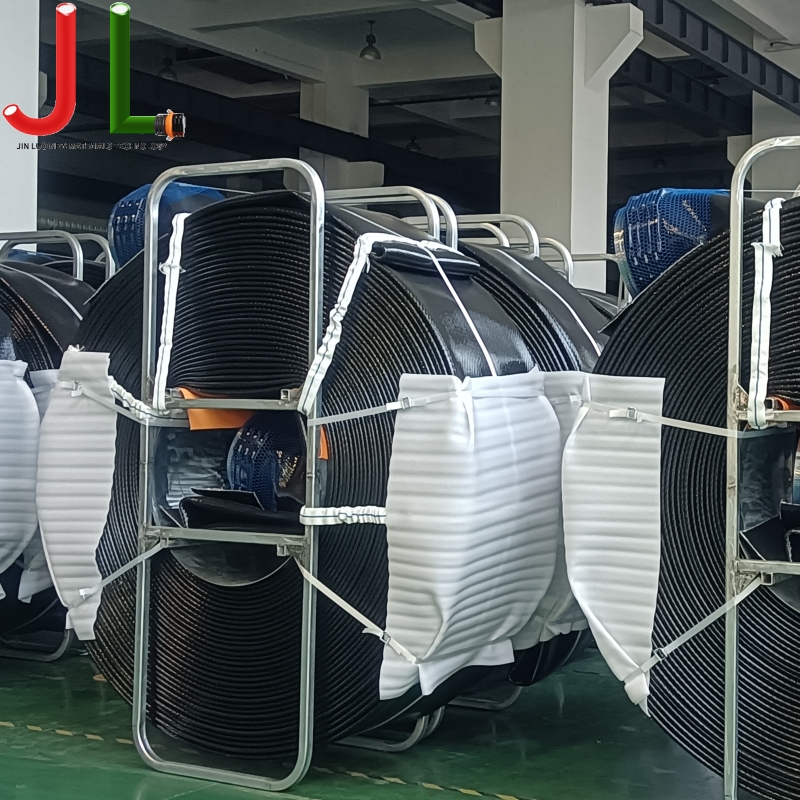
Manufacturers often use SBR (styrene-butadiene rubber) or CR (chloroprene rubber) for standard applications. For extreme abrasion environments, polyurethane-covered hoses offer three to five times the wear life compared to rubber covers. Field data indicates that polyurethane covers reduce replacement frequency by approximately 40% in high-friction applications such as fracturing manifold connections.
Understanding pressure ratings is fundamental to safe system design. Every Fracturing and Oilfield hose must have a clearly marked working pressure, which is typically 25% to 33% of the minimum burst pressure. This 4:1 or 3:1 safety factor accounts for pressure spikes, mechanical damage, and material degradation over time.
For high-pressure fracturing applications, a 15,000 psi working pressure is common, with burst pressures exceeding 60,000 psi. Engineers should also consider the impulse cycle rating, which indicates how many pressure cycles the hose can endure before fatigue failure. A quality fracturing hose should withstand a minimum of 200,000 impulse cycles at maximum working pressure per ISO 6803 testing protocols.
Hydraulic fracturing fluids contain a complex mixture of water, proppants, friction reducers, biocides, and scale inhibitors. The tube material must resist chemical degradation to prevent swelling, hardening, or extraction of compounds into the fluid stream. Chemical resistant fracturing hose for acidizing operations requires specialized tube compounds.
For acidizing treatments involving hydrochloric or hydrofluoric acid, fluorocarbon (FKM) tube materials provide the highest resistance. For standard fracturing fluids, HNBR offers a balanced combination of chemical resistance and temperature stability. Below is a summary of chemical compatibility considerations.
The hose assembly is only as strong as its end connections. For Fracturing and Oilfield hose assemblies with hammer unions, proper crimping techniques and coupling selection are critical. Hammer unions (such as Fig 100, Fig 1502, or Fig 206) are the industry standard for high-pressure fracturing connections due to their quick-connect capability and reliable sealing under extreme pressure.
When specifying assemblies, verify that the crimping process meets API 7K or ISO 6803 standards. Undercrimped connections can blow off under pressure, while overcrimping can damage the reinforcement layer, creating a hidden failure point. Third-party testing confirms that properly crimped assemblies maintain 100% of the hose's rated working pressure and burst pressure.
Compliance with recognized industry standards is non-negotiable for oilfield operations. API 7K is the primary standard for drilling and well-servicing hoses, covering design, manufacturing, and testing requirements. API 7K certified fracturing and oilfield hose ensures that the product has undergone rigorous burst, impulse, and bend testing.
Additional standards include ISO 6803 for impulse testing, ABS certification for offshore applications, and MSHA approval for underground mining environments. Procurement specifications should explicitly require certified test reports (CTRs) for each batch, documenting burst pressure, adhesion strength, and dimensional verification.

Request for a call today